
The Two-Strait War Opens a Multi-Front Threat Against Saudi Arabia — and a Potential Yemen Endgame
A Red Sea crisis, three-front threats, a defence pact and a maritime coalition — Riyadh is gradually unveiling an assertive regional strategy in public with strategic partners.

“In four weeks the Houthi campaign has moved from a declaration of maritime embargo against Saudi Arabia to a phased execution across four Saudi provinces, Red Sea trade and three Yemeni governorates. Riyadh has been assertively mobilising international support, recalibrating its response posture, redrawing rules of engagement, and weighing policy choices with the Government of Yemen and international partners.”
The Horizon Brief — 8 August 2026
Bottom Line Up Front
The Houthi escalation is highly likely to continue as a phased, IRGC-supported campaign. Each phase has widened the pressure arc while preserving reversibility margin, consistent with the incremental coercive model the militia has run since 2023.
Saudi Arabia now faces coordinated multi-front pressure: Iraqi militias striking the Eastern Province and Riyadh from the north, and the jihadist Houthi militia striking Jizan, Najran, Abha and Yanbu from the south, with maritime coercion in the Red Sea and Bab al-Mandab. Riyadh assesses this coordination as active and ongoing, and the geographic separation of launch points against a single target set is highly likely deliberate and pre-coordinated, chiefly designed to disperse Saudi air defences, complicate Riyadh’s response choices, and increase disruption geography and costs.
The current tempo of Houthi strikes is being sustained mainly from accumulated short-and-medium-range stockpiles dispersed across Marib, al-Jawf, Sana’a, al-Bayda, Sa’adah, Hodeidah and Taiz, which likely allows the rebels to maintain high-volume salvoes against Yemeni and southern Saudi targets while reserving its limited long-range inventory for long-range targets such as Yanbu.
Houthi participation in the strikes launched from Iraqi territory is likely on the balance of available reporting, and would confirm a network in which Iranian direction, Iraqi infrastructure, and Houthi expertise operate inside one joint operations room, as casualties document.
The 6–7 August Houthi militia’s strikes on Marib and Hadramawt governorates have at least four objectives: disrupting the operational and logistical planning of the Yemeni Armed Forces; degrading morale through mass casualties and panic; drawing the Government of Yemen into a war fought on Houthi timing and terms; and demonstrating sustained operational reach across and beyond the country.
Riyadh is shifting from strategic patience to incremental containment and mobilisation. The Multinational Maritime Defence Coalition, the Makkah Joint Defence Agreement and renewed security diplomacy with Baghdad are likely intended to secure burden-sharing, legal cover and pressure on the Iraqi launch corridor before, rather than after, any Yemeni decision on ground operations in Yemen.
A Yemeni government-led offensive, with external backing, is assessed as increasingly likely within the coming quarter, though execution will follow the visible exhaustion of diplomatic avenues, on the pattern Riyadh set with the STC in December. International tolerance for degrading the Houthis has widened materially given their recurrent threats to regional trade and security, as well as cross-border collaboration with Jihadist organisations, including AQAP, al-Shabab and ISS; consensus and full backing on the means has yet to tighten.
What Happened
The Axis target set in Saudi Arabia has widened in sequence, which carries clear intent. The Houthis opened the campaign with aviation: ballistic missiles against Abha International Airport on 13 July, fired hours after Yemeni forces reportedly struck the runway at Sana’a Airport to deny a US sanctioned Mahan Air landing. Then it moved to energy on 23–25 July, when the Houthis claimed missile and drone attacks on the Aramco facilities at Jizan and Yanbu — the refinery and the Red Sea terminus of the East–West Pipeline, which had absorbed the bulk of Saudi crude displaced from the Strait of Hormuz. It moved north on 27 and 28 July, when the Saudi Ministry of Defence reported intercepting drones aimed at petroleum facilities in the Eastern Province and the Riyadh region, launched from Iraqi territory. It returned south on 4 August with a high-precision Houthi drone strike on Najran Airport, which Houthi spokesman Yahya Saree framed as a response to Saudi drone activity over Saada and Hajjah, and which temporarily suspended operations after reported radar damage. These attacks also impacted civilians. On 6 August, the coalition spokesman Major General Turki al-Maliki reported that eleven people had been injured at Najran — seven Saudis, including a woman and a four-year-old child with second-degree burns, one Yemeni, two Egyptians and a Pakistani. Targeting four provinces from two launch theatres, the progression from military signalling to indiscriminate effect in twenty-four days underscores the scale of the threat.
The maritime campaign followed the same logic of phase escalation. Although the embargo declaration of 20 July carried no geographic boundaries, vessel definitions or enforcement criteria, the ambiguity transferred the burden of risk assessment onto owners, charterers and underwriters, before then threatening to target ships headed for Saudi ports. Claimed strikes on the VLCC Layla, carrying two million barrels of Saudi crude, and the tanker Encelia, carrying 730,000 barrels of diesel, on 22 July turned the declaration into an explicitly priced threat. The Houthi sinking of the India-flagged MSV Faize Noore Oliya by an explosives-laden boat 13 nautical miles south of Hodeidah on 4 August demonstrated once again the lethality of attacks; all fourteen crew, thirteen of them Indian nationals, were rescued by the Yemeni Coast Guard and taken to Mokha by the Red Sea. Claimed strikes on the Saudi tankers Wafa and Daisy followed on 5 August, the second tracked toward the Gulf of Aden. The extension of strikes into the northern Red Sea the same day showed intent to deny passage through the Suez Canal and SUMED rerouting that had absorbed diverted cargoes. The group’s method does not require closing Bab al-Mandab strait; it instead needs to raise the cost, risk and uncertainty of passage until commercial behaviour changes on its own.
Internally, the 6 and 7 August strikes inside Yemen were the Houthi campaign’s most consequential move. On 6 August, ballistic missiles fired from al-Jawf and Majzar struck camps at al-Rouaik in Marib and al-Thiniya and al-Abr in Hadramawt, hitting the Emergency Forces formations. The Ministry of Defence reported seventeen officers and soldiers killed and further wounded, with losses concentrated because troops had assembled for a morning exercise. Clearly, the Houthi targeting was informed by pattern-of-life knowledge and solid satellite, telecommunications, and human intelligence. On 7 August the Houthis shifted attacks to Marib city itself in successive waves; the Ministry of Health reported two civilians killed and fourteen injured, with homes and displacement shelters destroyed. Saree’s claims of hundreds of casualties should be discounted against the militia’s record of inflation, but the operational significance stands independently of the arithmetic: the Houthis struck the specific formations built to enable a government offensive, at the moment of maximum concentration, and immediately after Riyadh’s coalition acquired a command structure.
Riyadh’s response has been architectural as much as kinetic. Saudi and US CENTCOM jointly struck Iran-aligned sites in eastern Iraq on 29 July, with al-Maliki invoking Article 51 of the UN Charter; casualty figures circulating since are unofficial and contested, and Baghdad condemned the operation as a violation of sovereignty despite failing to prevent its territory being used as launchpad by Iraqi militias. The Multinational Maritime Defence Coalition was announced shortly anfter and named a commander on 6 August. The Makkah Joint Defence Agreement with Türkiye and Pakistan was signed on 7 August. On the same day, General Intelligence Presidency chief Khalid bin Ali al-Humaidan travelled to Baghdad to meet Prime Minister Ali Faleh al-Zaidi, conveying a leadership message renewing the invitation for al-Zaidi to visit Riyadh — a visit the Iraqi premier had immediately cancelled after the 29 July retaliation. Most recently, Al-Zaidi stated that Iraq would not permit its territory to be used to launch attacks against any other country, and both sides agreed to sustain intelligence sharing and security cooperation. The visit followed talks in Amman on 5 August between Prince Faisal bin Farhan and Fuad Hussein on arrangements for a senior Iraqi security delegation to travel to Riyadh. Sending the intelligence chief rather than a diplomat, days after striking pro-IRGC militia sites on Iraqi soil and amid signing a mutual defence pact, communicates the offer precisely: Riyadh will work the Iraqi file through Baghdad if Baghdad can credibly deliver, and around it if not.
The trajectory was mapped before it was executed. This Horizon Brief’s 14 July analysis identified the trigger cycle around the Sana’a–Tehran corridor and flagged more sophisticated Houthi strikes and an expanded Saudi target set as the markers of a shift from calibrated coercion to sustained escalation; the 16 July assessment placed Bab al-Mandab at a materially higher state of readiness with a publicly identifiable activation threshold, and concluded that Iranian pressure would push for consolidation of GCC alignment rather than fracture it; the 18 July brief named a strike on Yanbu or Houthi activation in the Red Sea as the specific events that would turn a Hormuz crisis into a two-strait crisis; and the 20 July analysis indicated the embargo’s significance prospective, contingent on whether a Saudi-directed measure widened into general disruption, and noted that Riyadh was weighing all available options. Each judgment has since been borne out.
Deployed Capabilities and Launch Geography
Mapping of Houthi firing positions over 5–7 August, according to on-ground and military sources, open-source reporting including by Defense Line and historical precedent, indicates a campaign run principally from accumulated short-and-medium-range arsenal that expanded materially after the April 2022 truce. Launches against Marib originated from the Jabal Hylan range in Sirwah district to the west, from positions around Mas camp in Madghal to the north-west, and from Majzar; further salvoes came from al-Fardha camp in Nihm east of Sana’a, from al-Aqsha’ and Ham ranges flanking al-Hazm in al-Jawf, and from al-Istiqbal and al-Ghoush camps in Hamdan district north of the capital — sites formerly housing the 1st Mountain Infantry and 170th Air Defence Brigades. Houthi ship-directed launches on 5 August were tracked from north-east of Taiz toward the Red Sea and from al-Sawma’a in al-Bayda toward the Gulf of Aden. Munitions are assessed as Zelzal, Burkan and Badr solid-fuel short-range systems, alongside Qasef-1 and Qasef-2K loitering munitions derived from the Iranian Ababil-2, multiple Samad generations, and Khatef, Rujum and Bayan types; Shahab and the Wa’id, derived from the Shahed-131/136 family, remain among the militia’s longer-range options. These identifications are indicative, based on multi-source reporting and trajectory analysis rather than recovered debris.
The same logic plausibly extends to the Saudi border provinces, with an important caveat. Najran and Abha sit within the reach of the solid-fuel short-range inventory and the smaller loitering munitions, which is consistent with high-tempo, low-cost salvoes against a border airport and an urban area from positions in Saada, Hajjah and al-Jawf. Yanbu, the Eastern Province and Riyadh sit well beyond that range and require longer range systems the rebels hold in far smaller numbers — or, as the Saudi Ministry of Defence reported on 27 and 28 July, launch from Iraqi territory. That distinction is the operational core of the multi-front problem: the southern front generates volume and attrition, the northern front generates multi-directional pressure, strategic reach, and the combination allows the IRGC network to threaten the Kingdom’s energy system without exhausting long-range missile and drone inventory. Houthi stocks are assessed to have been replenished through the Sana’a–Tehran corridor or the Red Sea coast, the continuity which will determine how long the current tempo can be sustained.
Two Straits, Three Fronts
The campaign is a contest over Saudi Arabia’s freedom of strategic and commercial movement. Iranian pressure keeps Hormuz barely usable; the Houthis threaten the principal alternative; Iraq supplies a northern vector against Riyadh and the Eastern Province. The Kingdom must defend its southern frontier, northern approaches, eastern production system, western terminals, major cities and two chokepoints simultaneously. The corridor became load-bearing shortly before it came under fire. Exports from Yanbu through Bab al-Mandab had reportedly reached 3.5 million barrels per day in June against 240,000 bpd a year earlier; the East–West Pipeline is running above 4 million b/d, roughly 400 per cent above pre-crisis levels; and some 7.4 million b/d of petroleum transits the strait.
Markets priced the risk within days. Brent rose above $99 on 23 July before easing; war-risk premiums increased by more than 200 per cent, from roughly 0.3 to 1 per cent of hull value; several underwriters froze war cargo cover for Saudi-linked vessels; and rerouting Asia-bound traffic around Africa adds over $1.6 million in fuel per voyage against four weeks of delay. Horizon Insights data record Bab al-Mandab transits falling to eleven vessels on 26 July and recovering to twenty-nine by 30 July, still 37 per cent below the July peak of forty-six, with fewer than ten vessels crossing Hormuz on the same days. A growing share of Saudi-linked tonnage transits with AIS disabled, so visible traffic understates actual flows while navigational opacity rises.
Selective passage remains the campaign’s defining feature. Beijing reportedly cleared individual Chinese-bound tankers carrying Saudi crude, over four of which transited after the embargo. Reuters has reported that the group is considering transit fees, anchored by Yemeni Information Minister Moammar al-Eryani, who alleged IRGC involvement and described plans for a dedicated collecting entity that would turn a strategic corridor into permanent revenue. The Houthi objective set extends well beyond shipping. Externally, the Houthis are improving the IRGC’s bargaining position by attempting to degrade or disrupt the primary bypass from Hormuz. Internally, the Jihadist militia is restoring coercive leverage over Riyadh, reframing the war as Saudi–Houthi rather than as an armed movement against the Yemeni state, and externalising domestic pressure driven by unpaid salaries, service failures, repression and tribal mobilisation.
The Iraqi Front
The Iraqi dimension has been over a decade in the making. As I set out in Leverage Beyond Yemen for Carnegie, the Houthis have deepened ties with the Popular Mobilization Forces and several pro-IRGC factions that yield political, economic, military and geopolitical returns, above all a means of pressure against the Gulf states — at the moment when the loss of Syria and the degradation of Hezbollah forced Tehran to redistribute its forward-defence strategy. Tamer Badawi’s reporting for Amwaj.media traced the same architecture from Baghdad, describing capacity built in parallel across Iran and Lebanon with the explicit aim of encircling Saudi Arabia from the north. Encirclement was practically declared long before execution.
Evidentiary records support the reading. Contacts date to at least 2012; a senior delegation sought assistance in Baghdad in 2015; ties deepened with Kataib Hezbollah, Harakat al-Nujaba, Kataib Sayyid al-Shuhada, Asaib Ahl al-Haq, the Badr Organisation and Alwiyat al-Waad al-Haq; a joint operations room was announced in 2024; and several jointly coordinated operations took place between 2021 and 2026. A US strike on a Kataib Hezbollah drone facility at Jurf al-Sakhar in July 2024 killed a Houthi missile officer and six other Houthi personnel, placing Houthi militia cadres inside Iraqi PMF missile and drone infrastructure. An Iraqi official has told The National that the Houthis maintain offices and residences across southern Iraq in contravention of Article 7 of the constitution, which obliges the state to prevent its territory being used as a base or transit route for terrorist activity.
Riyadh’s doctrinal answer was striking the enabling nod. It places Iraqi space and formations on the state payroll inside the target set during a government formation period, which is why al-Humaidan’s visit matters as much as the airstrikes did. The Kingdom, redrawing the rules of engagement through demonstrated assertive defensive posture, is offering Baghdad the opportunity to close the corridor politically before it is targeted again.
What All This Mean
The current trajectory indicates an overall preparation strategy ahead of any potential offensive. Formed on 30 July after a Riyadh meeting of military representatives from at least 43 states, the Multinational Maritime Defence Coalition comprises Saudi Arabia, Bahrain, Bangladesh, the Comoros, Djibouti, Egypt, Jordan, Kuwait, Pakistan, Qatar, Somalia, Sudan, Türkiye and Yemen. Rear Admiral Abdullah bin Salem Al-Shehri was appointed commander on 6 August to oversee joint naval defence, coordinate with member states and partner coalitions and supervise implementation of the charter; he has described the body as purely defensive and operating under the UN Charter. British officials have confirmed that a proposal to join is under active review, and a planning meeting on 12–13 August will complete the remaining institutional requirements and open the charter to further signatories. Neither the UAE nor Oman has joined, and Washington has not confirmed participation. Yemen’s seat is an important point: the Government now holds a place in a multilateral security architecture, perhaps for the first time since 2015.
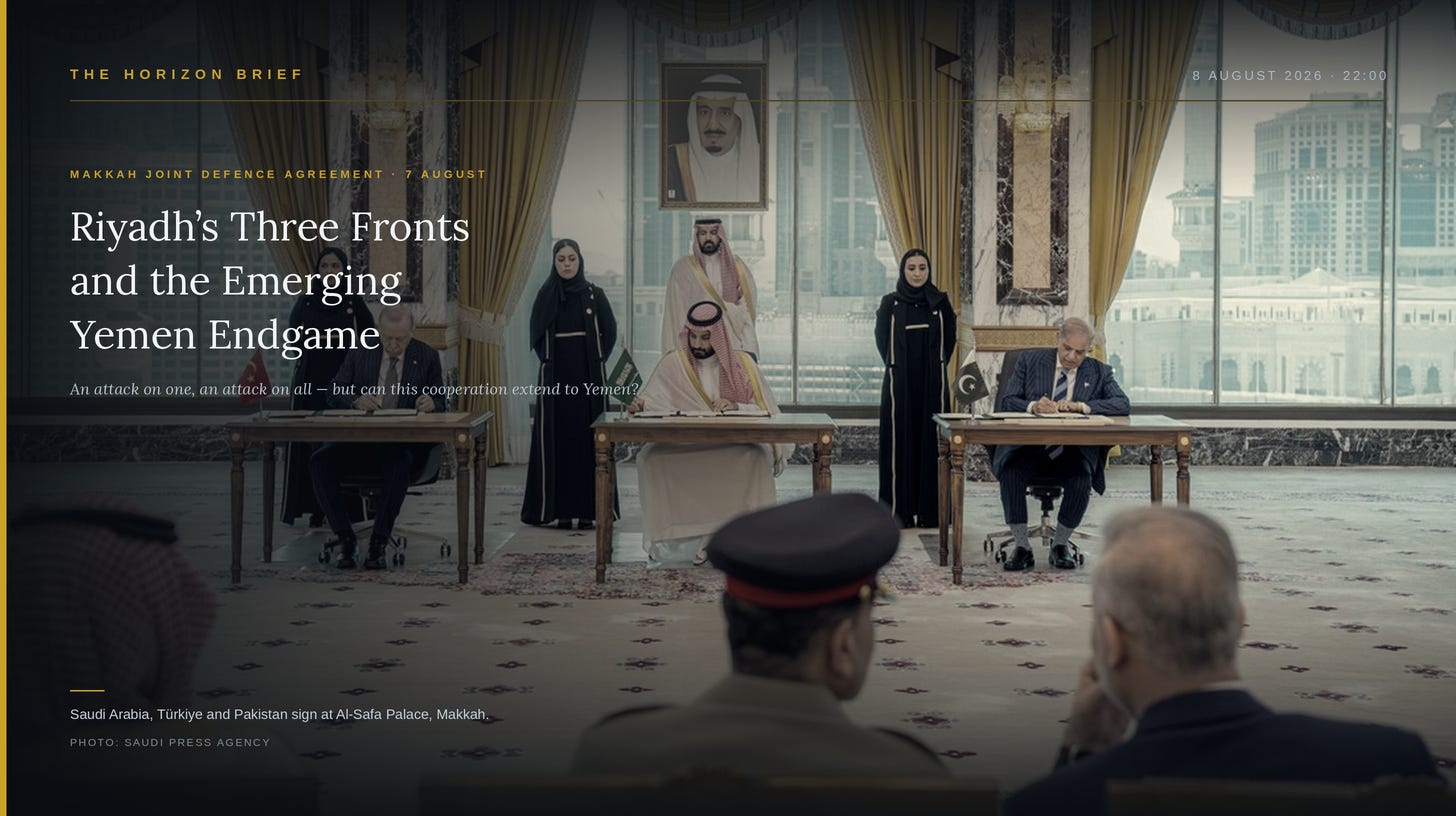
The Makkah Joint Defence Agreement, signed on 7 August at Al-Safa Palace by Crown Prince Mohammed bin Salman, President Erdoğan and Prime Minister Sharif, treats an armed attack on any one of the three states as an attack on all, extending the bilateral Saudi–Pakistani Strategic Mutual Defence Agreement of September 2025 to include Türkiye. A Turkish official has described the pact as defensive, not directed at any specific actor, and open to other regional states. Türkiye and Pakistan anchor both the coalition and the pact, and both bring capabilities directly relevant to Yemen. Ankara offers unmanned warfare systems and the industrial base behind them, intelligence and credible remote and electronic warfare experience, naval presence and NATO-standard training; Riyadh has been a significant customer for and partner of Turkish drones since 2023. Meanwhile, Islamabad offers ground-force training, advisory depth, border security experience and decades of technical assistance to Saudi forces. Both countries are well placed to underwrite a Yemeni government-led operation through training, enablers, intelligence and maritime tasking — the model that will support the move in a strategic direction. The logic is balancing through shared threats to regional security at a moment when the Axis of Iran has been in decay since 2024. Both Türkiye and Pakistan supply reach and expanded deterrence; Saudi Arabia offers economic clout, diverse cross-regional and international outreach, geographic depth, and the political umbrella. It also hedges against uncertainty over the durability of American commitments, a concern that has grown across the Gulf since February, with greater ownership of regional security arrangements. These developments may speak to local developments inside Yemen.
In a press statement issued on 7 August and circulated by Yemen’s Ministry of Foreign Affairs, Security Council members reaffirmed their commitment to Yemen’s sovereignty, independence, unity and territorial integrity, including sovereignty over its territory and airspace, and stressed that all flights into Yemeni airports must be coordinated with and pre-approved by the Government of the Republic of Yemen. Members condemned the unauthorised aircraft landings at Sana’a International Airport on 3 July and in Hodeidah on 13 July as breaches of international civil aviation rules; condemned Houthi missile attacks against Saudi Arabia and inside Yemen since 13 July and attacks on commercial vessels since 22 July; and underlined obligations under Resolution 2216 prohibiting the supply, sale or transfer of arms, technical assistance, training or financial support to designated individuals and entities, including the Houthis. The Council acknowledged the wider regional context, judged that these acts threaten regional security and the freedoms of navigation and portend further escalation, and renewed support for Special Envoy Hans Grundberg. The significance lies in what was condemned rather than in the condemnation itself: the Council placed the air corridor, the Houthi escalation and cross-border strikes, and the maritime campaign inside a single frame, and located the arms embargo at the centre of the response.
It is highly likely that Saudi Arabia and the Government of Yemen are actively weighing a military operation in Yemen against the backdrop of multi-front Houthi escalations seeking to pull the GoY to war on its timing and conditions. Mobilisation on both fronts, the Supreme Military Committee’s consolidation of anti-Houthi commands since January, the first government offensive air operations, and the assembly of maritime and defence architecture across late July and early August are best read as preparation of the ground. The Yemeni government’s reaffirmed that peace remains its first choice while the military alternative stands, and that Houthi conduct has brought mediation to an impasse. Drawing on the December precedent, operational execution follows the demonstrable exhaustion of diplomacy — and the August strikes make that exhaustion considerably easier to demonstrate, which is part of why the Houthis carried them out.
Military force must be guided by a compressive strategy. The threat radius and network are dispersed, politically shielded and technically adaptive with agility. Riyadh’s durable options combine persistent intelligence coverage across three theatres; layered air, missile and counter-UAS defence around energy and urban infrastructure; disruption of command, finance, logistics and procurement; hardened storage, pipeline and port redundancy; sustained pressure on Baghdad; genuine Yemeni partner capacity along the coast and inland; and a coalition with published rules of engagement, shared intelligence and real escort capacity. The aim should be to break the network’s ability to combine theatres.
What To Watch
1. Rhetoric and declaratory posture: whether IRGC, Houthis and PMF statements harden vis-a-vis Saudi Arabia or the GoY; chatter around talks in Muscat; whether Abdulmalik al-Houthi moves from “measure for measure” formula to expansion of targets, including members of the maritime coalition; whether Tehran further claiming direction openly rather than framing Houthi action as autonomous and attempts to include the Houthis in the uS-Iran talks like Lebanese file; whether Riyadh recalibrates its rethoric.
2. Attack forms, targets and reach: whether long-range systems reappear against Yanbu, the East–West Pipeline, western Red Sea ports, or the Eastern Province; whether further launches originate from Iraqi territory; whether the group redeploys more unmanned surface vessels, underwater arms, naval mines or complex attacks at scale; whether additional Saudi airports are targeted for disruption; whether strikes extend to Ras Tanura, Jubail or desalination infrastructure; whether attacks reach coalition or ASPIDES units.
3. Sustainment and resupply: whether firing rates from Sirwah, Madghal, Majzar, Nihm, al-Hazm and Hamdan hold or decay over successive weeks; evidence of replenishment attempts through the Sana’a–Tehran corridor, Hodeidah and al-Salif, or the Horn of Africa dhow routes; interdictions of solid-fuel precursors, propellant chemicals, servo units and navigation components; further Mahan Air attempts; whether foreign technical advisers are identified in future strike assessments.
4. Maritime access and market signal: whether a transit-fee entity is formalised and which flag states or carriers engage it; whether bilateral passage arrangements extend beyond the reported Chinese case to Indian, Omani, Japanese, Korean or European tonnage; the share of Saudi-linked tonnage sailing dark; whether underwriters withdraw cover ahead of any renewed fall in transits; Yanbu throughput against the June and July baseline.
5. Mobilisation and the ground picture: whether the deployments and operational security protocols of forces are reevaluated quickly based on a lessons-learned approach and shared across warfare theatre; whether government air operations move from calibrated response to sustained shaping; force concentration on the Marib, al-Jawf, Hadramawt, Hodeidah coastal and Sa’ada axes; humanitarian repositioning and contingency planning as an early indicator; whether UN Envoy Hans Grundberg’s shuttle tempo collapses.
6. Institutional and interdiction follow-through: whether UN Security Council language moves from press statement to resolution, and whether the arms embargo acquires enforcement mechanisms; Arab League and GCC ministerial positioning on the coalition; 2140 Panel of Experts findings on transfer routes; further OFAC designations against Houthi finance, procurement and shipping intermediaries; whether Asian states seek coalition roles after the sinking; whether al-Zaidi’s Riyadh visit proceeds and what the Iraqi security delegation delivers on launch-site controls in western and southern Iraq.
7. Coalition and alignment: outcomes of the 12–13 August planning meeting, including charter signatures, rules of engagement and command architecture; UK accession and US participation; hull commitments and escort tasking as distinct from political signature; deconfliction with ASPIDES, ATALANTA and Combined Maritime Forces; the first Turkish or Pakistani contributions under the Makkah framework and whether they extend to Yemen; whether the UAE or Oman accede or hold to a separate approach; Iranian naval deployments south of Bab al-Mandab and wider forward basing developments in Djibouti, Eritrea and Somaliland.
If this analysis was useful, share it with one person who should be reading it. Hence, subscribe to The Horizon Brief for rigorous, intelligence-grade analysis of regional developments as they unfold.